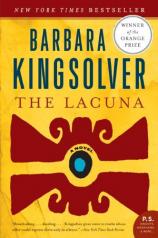
The Lacuna


Review
The Lacuna




Although her last full-length novel released in 2000, it’s not as if Barbara Kingsolver has just been sitting around for the past nine years. As her avid readers know, she recently moved to a new part of the country, took up farming, only ate local cuisine for a year, and wrote about the experience in her bestselling memoir, ANIMAL, VEGETABLE, MIRACLE. And, apparently, Kingsolver has been spending a great deal of time researching the history of North America in the 20th century in preparation to write her splendid new novel, THE LACUNA.
At the center of the book is Harrison William Shepherd, son of an American man and a Mexican woman of Spanish descent. His beautiful, glamorous mother disdains the Indians and mestizos who populate the Mexican household where she moves with her young son in the late 1920s, after separating from her husband. During the course of Shepherd’s childhood, his mother is the mistress of a long string of prominent married men, many of whom regard Shepherd as a nuisance at best. The boy retreats to the kitchen, where he learns how to make dozens of varieties of bread, and to the ocean, where he teaches himself how to hold his breath for up to two minutes. This is the length of time required to swim through an underwater cave --- or “lacuna” --- to a mysterious hidden cenote, or flooded sinkhole. Both these skills will serve Shepherd well over the course of his life, but none will define him as much as the ability to effectively make himself invisible both in his life and in his writings.
As a young boy, Shepherd takes up the habit of journaling, recording virtually everything his mother and the household staff do or say --- a process that at times infuriates his mother. What’s notable about Shepherd’s writings is that he manages to, more often than not, erase his own identity from the narrative. As the “editor” of his journals points out in an introductory essay, “Anyone else would say in a diary, ‘I had this kind of a supper,’ but to his mind, if supper lay on the table it had reasons of its own. He wrote as if he’d been the one to carry the camera to each and every one of his life’s events, and thus was unseen in all the pictures.” This curious absence results in a challenging reading experience as one must piece together Shepherd’s life largely through not only what is said about him but also through what is missing (appropriately enough, the word “lacuna” also means something that is left out). One whole section of Shepherd’s life is left out, since (as Shepherd’s editor helpfully tells us) the journal in question was burned, for reasons that readers will soon discern.
Following a life-altering but ultimately disastrous stint at a military boarding school back in the States, Shepherd returns to Mexico, where he revives an earlier acquaintanceship with the tumultuous duo of painters Diego Rivera and Frida Kahlo. The famously volatile, brilliant pair have enough personality of their own to make up for Shepherd’s lack. As the couple’s cook and typist, Shepherd is also an astute witness to their artistic gatherings, political intrigues and sexual liaisons. Particularly, when the exiled Lev Trotsky and his wife show up on the scene, the bohemian, nationalistic Rivera household is vibrantly framed through Shepherd’s carefully observant lens.
These years form the heart not only of Shepherd’s life but also of the novel. Later, when he returns to America to become a successful novelist in his own right, the novel loses a bit of its exciting edge. It would be hard for anyone --- especially a writer whose tendency is to lose himself in his own narrative --- to live up to the dynamic personality of Diego and Frida, so this change in tone isn’t too surprising. What’s remarkable, however, is Kingsolver’s ability to consistently maintain Shepherd’s self-erasing authorial voice nested within her own energetic prose. Shepherd is the consummate observer, the supporting player in his own life, which is in itself notable primarily because of its proximity to historical change and cultural figures, its unique positioning on the border of two increasingly intertwined cultures.
As Kingsolver’s title suggests, the narrative is composed not only of what is written but also of the space between, space that the reader feels compelled to fill, creating a complicit partnership between author and reader and a most satisfying reading experience.
Reviewed by Norah Piehl on December 30, 2010


The Lacuna
- Publication Date: July 20, 2010
- Genres: Fiction
- Paperback: 544 pages
- Publisher: Harper Perennial
- ISBN-10: 0060852585
- ISBN-13: 9780060852580