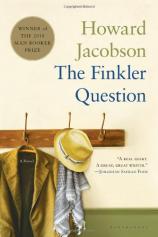
The Finkler Question
by Howard Jacobson
List Price: $15.00
Pages: 320
Format: Paperback
ISBN: 9781608196111
Publisher: Bloomsbury USA
"He should have seen it coming. His life had been one mishap after another. So he should have been prepared for this one…"
Julian Treslove, a professionally unspectacular former BBC radio producer, and Sam Finkler, a popular Jewish philosopher, writer and television personality, are old school friends. Despite a prickly relationship and very different lives, they've never quite lost touch with each other --- or with their former teacher, Libor Sevcik, a Czech always more concerned with the wider world than with exam results.
Now, both Libor and Finkler are recently widowed, and with Treslove, his chequered and unsuccessful record with women rendering him an honorary third widower, they dine at Libor's grand, central London apartment.
It's a sweetly painful evening of reminiscence in which all three remove themselves to a time before they had loved and lost; a time before they had fathered children, before the devastation of separations, before they had prized anything greatly enough to fear the loss of it. Better, perhaps, to go through life without knowing happiness at all because that way you have less to mourn? Treslove finds he has tears enough for the unbearable sadness of both his friends' losses.
And it's that very evening, at exactly 11:30 pm, as Treslove, walking home, hesitates a moment outside the window of the oldest violin dealer in the country, that he is attacked. And after this, his whole sense of who and what he is will slowly and ineluctably change.
The Finkler Question is a scorching story of friendship and loss, exclusion and belonging, and of the wisdom and humanity of maturity. Funny, furious, unflinching, this extraordinary novel shows one of our finest writers at his brilliant best.
top of the page

1. Treslove’s romantic history begins with a fortune-teller’s reading in Barcelona. She says of his future, “I see a Juno --- do you know a Juno?” (4) What impact does this prediction have on Treslove’s life? Where does he find “Juno,” and where is he led astray in his search for love?
2. After the mugging, “Treslove was not willing to accept that he had encountered a person with a screw loose, or that he had just happened to be in the wrong place at the wrong time.” (109) Why can’t Treslove believe that the mugging was random? Why is he so convinced that the incident has meaning? How does it leave him “like a man on the edge of a discovery”? (57)
3. Consider the rivalry between Treslove and Finkler, from school days to adulthood. How did their unspoken competition begin? What “yardsticks of success” (44) do they use to measure each other’s lives? Who seems to be leading in their rivalry at the beginning of the novel? What about at the end?
4. Treslove realizes that after the mugging, he is becoming “an unreliable witness to his own life.” (82) How reliable is Treslove’s point of view in The Finkler Question? Can the reader trust his perceptions? Why or why not?
5. What kind of “Finkler” is Sam Finkler? Is he representative of the Jewish people, as Treslove assumed when he was a boy? Why or why not?
6. Treslove, Finkler, and Libor have all had winding career paths. Trace each man’s job history from his youth to adulthood. Why do you think all three friends have lived such varied lives?
7. Consider the meaning of parenthood in the novel. How did Treslove and Finkler feel about their fathers? How do they treat their own children? What alternatives to family do childless characters like Libor and Hephzibah seek out?
8. Describe Finkler’s rise and fall as the leader of the ASHamed Jews. Why does Finkler insist on publicizing his distaste for Israeli politics? Why does he eventually leave the group?
9. Consider the seder that Treslove attends at Libor’s house. How is this seder unique? How does this scene serve as a turning point in the novel, linking part one and part two? What changes for Treslove during his first Jewish holiday?
10. According to Hephzibah, “You could divide the world into those who wanted to kill Jews and those who wanted to be Jews.” (224) Where do Treslove, Finkler, and Libor fit within Hephzibah’s categories? Is it possible to belong to neither or both categories? In contrast, Libor tells Treslove, “We’re all anti-Semites. We have no choice. You. Me. Everyone.” (249) Which assessment of Jews and anti-Semites is more accurate: Hephzibah’s, Libor’s, or neither?
11. Discuss the role of women in The Finkler Question. What insights do the women in the novel have about their husbands, boyfriends, and ex-boyfriends? What do Treslove, Finkler, and Libor learn from women, and what relationship lessons do they never learn?
12. Why does Treslove tell Libor about his affair with Tyler Finkler? Libor says that it was “more wrong of you to tell me than to do it.” (247) Which is more unforgivable: the affair or the confession? What are the repercussions of each of these indiscretions?
13. Consider Libor’s mental state throughout The Finkler Question. How does he express his grief over losing Malkie? Why does he attempt to date women while in mourning? What, in the end, drives Libor to suicide? Is his suicide an act of love, of defeat, or something else?
14. Near the end of the novel, Treslove encounters two people from his past: “the schoolgirl in his once recurring dream” who calls him a “freak” (299), and the “grizzled warrior Jew in the PLO scarf” holding a silent vigil outside the museum. (303) What impact does each of these characters have upon Treslove’s state of mind? Why is it significant that Treslove confronts two recurring characters in these final scenes?
15. The Finkler Question ends on a scene of mourning: Hephzibah lamenting Libor’s death and the end of her relationship with Treslove, and Finkler “mourning the Jewish people” as a whole. (307) Why does this humorous novel end on a note of mourning? What is the tone at the end of the novel? What issues are resolved, and what remains unresolved?
16. Discuss the use of humor in The Finkler Question. Is the novel’s humor specifically “Jewish humor,” or does it have broader appeal? Which scenes best represent the novel’s dark sense of humor?
top of the page

"Mr. Jacobson doesn’t just summon [Philip] Roth; he summons Roth at Roth’s best. This prizewinning book is a riotous morass of jokes and worries about Jewish identity, though it is by no means too myopic to be enjoyed by the wider world. It helps that Mr. Jacobson’s comic sensibility suggests Woody Allen’s, that his powers of cultural observation are so keen, and that influences as surprising as Lewis Carroll shape this book…Even in its darkest moments The Finkler Question offers many examples of… the most pernicious and authentic strain of Jewish humor: the kind that’s so real it isn’t funny at all."
The New York Times
"Like all of [Jacobson’s] work, The Finkler Question has a kind of energy that you have to look at through your fingers, like an eclipse. As the brightness of his brilliance is hard to look at, so is the darkness of his humor. I don't know a funnier writer alive."
Jonathan Safran Foer
"The Finkler Question tackles an uncomfortable issue [Jewish identity] with satire that is so biting, so pointed, that it pulls you along for 300 pages and leaves a battlefield of sacred cows in its wake… Like all great Jewish art…it is Jacobson’s use of the Jewish experience to explain the greater human one that sets it apart…It’s a must read, no matter what your background."
National Public Radio
"Rare is a work of fiction that takes on the most controversial issues facing Jews so directly --- and with enough humor, intelligence, and insight --- that it changes a reader’s mind or two. Be warned: The Finkler Question will probably distress you on its way to disarming you. Can we pay a novel any greater compliment?"
Barnes and Noble Book Review