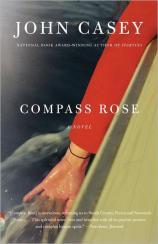
Compass Rose


Review
Compass Rose




In SPARTINA, winner of the 1989 National Book Award, readers were introduced to South County, Rhode Island, in the 1980s, an area that has benefitted and suffered from sprawling developments. It has been the home for many generations of small fishermen and farmers, but as the rich encroach, they bring with them expensive tastes and modern needs. Old-timers are blue-collar workers, fathers and sons who proudly harvest their livelihoods with their own hands, sailing the open seas in search of swordfish and emptying their pots to market fish on the piers. Ultimately, small fishermen are barely surviving in this life, but they are free and enjoy an unencumbered, solitary existence.
Dick Pierce is an old fixture here, a kind but hard man who knows the marshes, stubborn and restless, completely ingrained in tradition. He uses his knowledge about all things nautical to build a dream: a custom boat he has designed himself. Believing the sea will provide, Dick pours every last cent into this pinnacle of his achievements and labors on it whenever he gets the cash. He finally finishes after years of sacrifice by his family and names the ship the Spartina May --- both for his wife and in honor of the hardy native grasses that grow in the Salt Marshes.
Yet somewhere in his mania to see his dreams live, Dick was seduced and engaged in a secret affair with beautiful, lithe Elsie Buttrick, a Natural Resources officer who he has known since she was a girl. At the time, Dick kept his wife and lover separate in his compartmentalized mind, knowing all the while that he would eventually have to face the consequences. Elsie, however, looked at it as an act to be considered free and apart from any shame or wrongdoing. They ended it after realizing their secret had already hurt many people. Elsie now rears their child alone --- a little girl who Dick is content never to know --- while Dick returns to his two sons and the ruins of his marriage.
Still crude and free-spirited, Elsie has come to terms with giving up Dick for good, happy in her chance to raise their child alone. Dick is out at sea constantly in the Spartina May, leaving May to the solid, lonely foundations of her house and garden. Understandably, May remains bitter about his transgressions, and, realizing that the entire town is bound to find out eventually, gets the gumption to go meet Dick's baby daughter, Rose. May presents an agreement to Elsie that will allow Rose to become a part of May's family and give her the opportunity to get to know her brothers and father.
COMPASS ROSE takes readers through Rose's childhood as she's being raised by Elsie and her friend Mary and also by May and Dick. This strange scenario works well because all parties are committed to it, and May quickly loves Rose as much as she would her own children. Halfway through, the book jumps forward to Rose's stormy adolescence, wherein all parties play a major role in supporting her.
As in SPARTINA, there is real greatness to John Casey's writing in COMPASS ROSE, which provides a realistic window into the lives of those who make their living off the Salt Marshes of Rhode Island. There are many lovely, sharp details surrounding the scenery of this estuary, and characters are complicated and fascinating --- especially young Rose. I did tire, tough, of the endless erotic scenes, which (like in SPARTINA) are written so intimately as to give the reader a hefty sense of outright voyeurism and discomfort at times. I also had misgivings about the workability of this kind of "modern family," whose members --- while admirable in their capacity to accept and love --- enter into an arrangement that borders on frank polygamism.
I did appreciate the quality and emotional appeal of the writing, however, and recognize it as worthy literature. Any interested readers who have not yet read SPARTINA will need to do so first as you'll find it's essential to completing this interesting family drama.
Reviewed by Melanie Smith ([email protected]) on October 3, 2011


Compass Rose
- Publication Date: October 4, 2010
- Genres: Fiction
- Paperback: 400 pages
- Publisher: Vintage
- ISBN-10: 0375709134
- ISBN-13: 9780375709135