IndieBound Independent Bookstores BRC Facebook Fan Page
Reading Group Guide
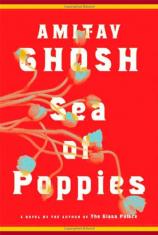
Sea of Poppies
by Amitav Ghosh

List Price: $15.00
Pages: 560
Format: Paperback
ISBN: 9780374174224
Publisher: Picador

Click here to buy this book from Amazon.com.
Click here to buy this book from Amazon.ca.


About This Book

Turning his eye to the nineteenth-century opium trade, the acclaimed author Amitav Ghosh has crafted a novel that is by turns witty and provocative, while delivering a magnificent historical adventure. An intricate saga, Sea of Poppies brings together a motley array of sailors and stowaways, coolies and convicts, who have embarked on a tumultuous voyage across the Indian Ocean in the midst of the Opium Wars between Britain and China. This panorama of characters, including a mulatto freedman from America, a bankrupt raja, a beautiful, free-spirited French orphan, a widowed tribeswoman, and other disparate members of society, brings to life a period of colonial upheaval that caused seismic cultural shifts throughout the globe. The events transpiring aboard the Ibis (a former slave ship) provide a rich tapestry of a time when the world stood poised to witness some of the most profound destruction --- and most sweeping liberation --- in the history of humanity. From the lush poppy fields of the Ganges to the crowded backstreets of Canton, across a rolling high sea that beckons throughout the narrative, this is a portrait of fateful events you will not soon forget.

top of the page


rgg_discuss.gif (1294 bytes)

1. Discuss how the relationships between the various classes of people aboard the Ibis change throughout the novel. To what extent does the caste system affect these relationships? Which characters undergo the most significant changes?

2. How are women’s roles different from men’s in Sea of Poppies? What common ground do Deeti, Paulette, and Munia share?

3. What does the Ibis represent to Zachary at various points in the novel? How does his perception of the ship change as his perception of himself changes?

4. Many of the lives Ghosh depicts are shaped by social and political forces beyond their control. What are some of these forces? Describe some of the individual acts of bravery, defiance, or deception that enable his characters to break free from what they see as their fate.

5. How do those involved in the opium trade, from British factory owners to frontline harvesters, justify their work in Sea of Poppies? How does their industry compare to modern-day drug trafficking versus the pharmaceutical industry?

6. When Mr. Burnham gives religious instruction to Paulette, what does he reveal about his mindset in general? How does he balance his shame with his attitudes toward suffering, including his notion that slavery somehow yields freedom?

7. Discuss the power of love as it motivates the characters. Does obsession strengthen or weaken Baboo Nob Kissin? What kind of love is illustrated when Deeti gives up her child? What kinds of love does Neel experience in the presence of his loyal wife and his fickle mistress?

8. What gives Neel the ability to endure Alipore Jail and his subsequent voyage? Does he feel genuine compassion for his cell mate, or is he simply trying to make conditions more livable for himself? Ultimately, who is to blame for Neel’s conviction?

9. How did Paulette’s free-spirited upbringing serve her later in life? What advantages and disadvantages did she have?

10. What does Zachary teach Jodu about loyalty and survival? How is trust formed among the suspicious Ibis crew?

11. To what degree is Mr. Crowle powerless? What does the future hold for those who defied him?

12. Which historical aspects of the Opium Wars surprised you the most? What did you discover about colonial India by reading Sea of Poppies?

13. Sea of Poppies makes rich use of Asian-influenced English. Some of the words, such as bandanna, loot, and dinghy, are still used frequently, but many others, like bankshall, wanderoo, and chawbuck, are now rare, although they were once common and are included in The Oxford English Dictionary. Discuss the Ibis Chrestomathy, which appears at the end of the book. What do Neel’s observations suggest about language and culture? Why do you think some words disappear from usage, while others endure? Can a culture’s vitality be measured by how eagerly its language absorbs outside influences?

14. In an interview with TheBookseller.com, Ghosh stated that “oil is the opium of today.” Do you agree or disagree?

15. How does Sea of Poppies reflect themes you have observed in Amitav Ghosh’s previous works? What new issues does he explore in this novel?

top of the page

Critical Praise

"[A] remarkably rich saga . . . which has plenty of action and adventure à la Dumas, but moments also of Tolstoyan penetration—and a drop or two of Dickensian sentiment."
— Adam Mars-Jones, The Observer


"India in the 1830s is wonderfully evoked—the smells, rituals and squalor . . . Coarseness and violence, cruelty and fatalism, are relieved with flashes of emotion and kindness. This is no anti-colonial rant or didactic tableau but the story of men and women of all races and castes, cooped up on a voyage across the ‘Black Water’ that strips them of dignity and ends in storm, neither in despair nor resolution. It is profoundly moving."
— Michael Binyon, The Times


"[A] terrific novel . . . Ghosh provides the reader with all manner of stories, and equips himself with the personnel to man and navigate an old-fashioned literary three-decker . . . Yet for all its research, Sea of Poppies is full of the open air. It never, as the eighteenth century used to say, ‘smells of the lamp."
— James Buchan, The Guardian 


"The seaboard sections rival those in Melville and Conrad, but the scenes ashore are equally gripping and one leaves this long page-turner wishing it could continue. One waits eagerly for its sequels. Sea of Poppies is a tremendous novel . . . [The] ‘Ibis’ trilogy will surely come to be regarded as one of the masterpieces of twenty-first-century fiction."
— John Thieme, The Literary Review

 
Back to top.   


Privacy Policy | Contact Us | Advertising | About Us

© Copyright 2001-2009, ReadingGroupGuides.com. All rights reserved.
The Book Report, Inc. • 250 West 57th Street • Suite 1228 • New York, NY • 10107
Ph: 212-246-3100 • Fax: 212-246-4640

Bookreporter.comReadingGroupGuides.comGraphicNovelReporter.comFaithfulReader.com
Teenreads.comKidsreads.comAuthorsOnTheWeb.comAuthorYellowPages.com