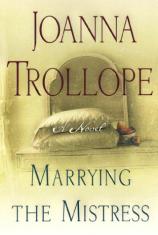
Marrying the Mistress


About the Book
Marrying the Mistress



It is not an unusual story: A married man falls in love with another woman. He decides to end his marriage and start a new life with his mistress. This decision sends shock waves throughout his family, disrupting not only his life, but the lives of his children, their respective partners, and their children. What is unusual, perhaps, is the sensitive way Joanna Trollope's provocative novel examines the repercussions of such an affair on family members. Her portrait of the Stockdale family-its married and unmarried couples, the parents and their children, grandparents and grandchildren, sisters and brothers-reveals the wonderful and sometimes terrible ways people respond to one another in a crisis of the heart. Before Guy and Merrion take the tumultuous step to be together, the Stockdale family resembles many middle- and upper-class families. A prominent judge with two grown sons, Guy is neither demonstrative nor neglectful as a husband and father. His wife, Laura, has dedicated herself to raising her children and making a comfortable home. Birthdays and anniversaries are remembered, gardens are tended, work gets done-and problems are tactfully swept under the rug. But some problems simply won't stay put. And as Guy's passion for Merrion grows, he realizes how unhappy he is in his marriage to Laura. This realization, and the steps he takes to address it, create a chain reaction of self-examination that exposes the considerable fault lines beneath the surface of nearly every relationship in the Stockdale family. And they are relationships worth examining, not least because Trollope's characters are so richly drawn that their stories feel both unique and universal. By blending moments of intense emotion with intricately wrought scenes of domestic life, Trollope skillfully conveys the euphoria of new love through the eyes of both a sixty-year-old man and a sixteen-year old boy. She walks readers through the desolation of a not-quite-elderly-and certainly not grown-up-woman's broken heart as well as the haphazard and fragile days of a self-conscious adolescent girl. And somewhere in between we come to know Simon and Merrion, tentatively straddling the path between youth and middle age, painfully coming to terms with the doubts that arise when you realize that you're not going to have everything you want in life, and trying to figure out what is worth sacrificing and what is necessary for happiness. An acute and observant chronicler of modern life, Trollope raises important questions about family and marriage, loyalty and responsibility. Should we root for Guy, who seems to have found happiness in a bright, energetic and lovely woman who happens to be younger than his own children? Should we sympathize with Laura who, though clearly demanding, self-involved, and possibly unlovable, is nonetheless forced to rebuild her life at a less than tender age? To whom does Simon owe his loyalty: his mother, who has always depended on him and now seems to need him more than ever; or his wife Carrie, whose own capable nature has made her both indispensable and invisible? And what about Merrion? Should the Stockdale children welcome her for the joy she brings to Guy's life? Or treat her like an interloper, for the havoc she has brought to theirs? There are no easy answers, nor should there be. We may not agree with these characters' choices or actions, but we can empathize with the complexity of their predicaments because real life is messy-it doesn't matter if a home is as beautifully appointed as Laura's, with its country garden and embroidered cushions, or as cluttered and unkempt as Carrie's, with its dish-strewn kitchen and creaky pipes. The messiness comes from caring for other people-whether or not the object of that devotion is socially acceptable; whether or not the object of that devotion wants to be desired. The shock waves that emanate from Guy and Merrion's relationship tempt us to carry the earthquake analogy one step further: After the tremors have subsided, leaving those buildings with strong foundations still standing while weaker ones have crumbled, it is time to assess the damage; to demolish what can't be saved and reinforce what remains. It is an opportunity to rebuild for the future, and to be stronger than ever.


Marrying the Mistress
- Publication Date: June 5, 2000
- Hardcover: 293 pages
- Publisher: Viking Adult
- ISBN-10: 0670891509
- ISBN-13: 9780670891504