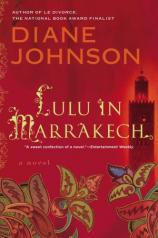
Lulu in Marrakech
by Diane Johnson
List Price: $15.00
Pages: 320
Format: Paperback
ISBN: 9780452295599
Publisher: Plume
The two-time Pulitzer Prize- and three-time National Book Award-nominated author of the bestseller Le Divorce returns with a mesmerizing novel of double standards and double agents.
Lulu Sawyer, the heroine of Diane Johnson's captivating new novel, arrives in Marrakech, Morocco, hoping to rekindle her romance with a worldly Englishman, Ian Drumm. It's the perfect cover for her assignment with the American CIA: tracing the flow of money from well-heeled donors to radical Islamic groups. While spending her days poolside among Europeans, in villas staffed by local maids in abayas, and her nights at lively dinner parties, Lulu observes the fragile coexistence of two cultures which, if not yet clashing, have begun to show signs of fracture. Beneath the surface of this polite expatriate community lies a more sinister world laced not only with double standards, but with double agents.
As she navigates the complex interface of Islam and the West, Lulu stumbles into unforeseen intrigues: A young Muslim girl, Suma, is hiding from a brother intent on an honor killing; and a beautiful Saudi woman, Gazi, who is vying for Ian's love, leaves her husband in a desperate bid to escape her repressive society. The more Lulu immerses herself in the workings of Marrakech, the more questions emerge; and when bombs explode, the danger is palpable.
Lulu's mission ultimately has tragic consequences, but along the way readers will fall in love with this endearing young woman as she improvises her way through the souk, her love life, and her profession. As in her previous novels, Diane Johnson weaves a dazzling tale in the great tradition of works aboutnaive Americans abroad and the laws of unintended consequence, with a new, fascinating assortment of characters, as well as witty, trenchant observations on the manners and morals of a complicated moment in history.
top of the page

1. Reread the prologue in E. M. Forster’s A Passage to India. How did you interpret it before reading the novel, and how do you interpret it now?
2. On the very first page, Lulu Sawyer discusses Americans’ tendency toward gullibility, that “our ability to fool ourselves is greater than the ability of others to fool us.” In what ways was she describing herself? How did that help or hinder her in her work?
3. Given Lulu’s line of work, trust is a major theme throughout the novel. Who turns out to be most trustworthy? Least? What about Lulu herself?
4. At the bottom of page 47, Lulu confesses that she hates to bargain, probably because of the lying implied in the transaction. How does this jibe with her chosen career? What about her notion of victory and defeat that are embedded within any bargain?
5. Sexism affects all of the women in the novel, in both religious and institutional terms. How is the sexism Lulu faces from her colleagues different than the sexism Suma and Gazi face in their daily lives, if it is in fact different?
6. Lulu seems to be suspicious of Ian almost from the beginning, and yet she falls in love with him. What does this say about her aptitude for her job? How might she have handled things differently?
7. What role do Posy and Robin play in the novel? If they weren’t in this precise setting, do you think Posy and Lulu would be friends? Which would you rather have as a friend?
8. Discuss the character of Colonel Barka. How did he use Lulu, and vice versa? Ultimately, was he a “good guy”?
9. On page 192, Taft lumps Gazi and Suma together. Do you imagine the Muslim men do the same with Lulu and Posy? What is the effect of this stereotyping?
10. How is the way Taft approaches his job different from the way Lulu approaches hers? In what ways is each one’s method more effective?
11. On page 206, Lulu adopts a line from T. S. Eliot as a mantra: “Prayer, observance, discipline, thought and action.” How well does she follow through on that notion?
12. Lulu accepts the notion of ambivalence as being “built into life in the shadows; even as you hope for unshakable convictions, you feel them drain away” (page 251). How has her experience in Marrakech weakened her convictions? How strong were they to begin with?
13. After Amid’s death, Lulu feels that her guilty conscience is “not so much a moral qualm as chagrin at having screwed up” (page 265). What does this say about her character? Is she better suited to her job than she appeared to be?
14. Reread the letter from Ian’s father to Lulu on page 266. How did you interpret it when you first read it? Did your interpretation change as you read further?
15. Why does Suma steal the notebook from Khaled? Why does the colonel pass it on to Lulu?
16. After reading Gazi’s letter, Lulu thinks, “It helped me understand what had gone wrong between her and Ian, if anything had: She was too dumb” (page 306).What makes her think this? Why did Gazi write to her?
17. Lulu imagines herself to be the Ingrid Bergman character in the film Notorious, with Ian in the Cary Grant role and Lord Drumm as Claude Rains (page 295). Have you seen the film? Do you think her casting is accurate?
18. 6. Discuss the ending. Was it satisfying to you? In what ways did it surprise you? What questions, if any, do you still have about what happened?
top of the page