Reading Group Guide
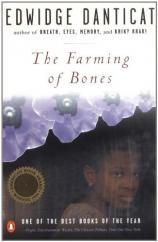
The Farming of Bones
by Edwidge Danticat

List Price: $12.95
Pages: 312
Format: Paperback
ISBN: 0140280499
Publisher: Penguin USA

Click here to buy this book from Amazon.com.
Click here to buy this book from Amazon.ca.


About This Book


Testimony: An Introduction to
The Farming of Bones

"His name is Sebastien Onius. Sometimes this is all I know. My back aches now in all those places that he claimed for himself, arches of bare skin that belonged to him, pockets where the flesh remains fragile, seared like unhealed burns where each fallen scab uncovers a deeper wound."

The Dominican Republic and Haiti. Two countries sharing the same island—one poor, the other poorer. For decades, Haitians attempting to escape their country's abject poverty have streamed into the Dominican Republic to work as laborers in the sugarcane fields or as domestic help. In 1937, longstanding hostility between the two countries erupted, and Generalissimo Rafael Trujillo Molina decreed the slaughter of all Haitians on Dominican land. This is the historical backdrop for The Farming of Bones.

Amabelle, the heroine of Edwidge Danticat's haunting new novel, and her lover Sebastien are two such Haitian laborers who find themselves caught in the massacre of 1937. Amabelle—orphaned at a young age when her parents drowned in the river that separates the two countries—is a housekeeper for Seņora Valencia and her husband General Pico, who is supremely devoted to Generalissimo Trujillo. Sebastien cuts cane, the act from which Danticat draws the title of her book. It is called "the farming of the bones" because after a day in the searing heat of the fields, anticipating snakes and rats, brushing up against the razor sharp edges of the cane, the workers find their skin is shredded, their bones closer to the surface than the day before.

Indeed, The Farming of Bones abounds with complex shades of meaning. In the first few chapters of the novel, Amabelle helps Seņora Valencia give birth to twins. When the doctor finally arrives to check on the newborns' health, he says to Amabelle, "Many of us start out as twins in the belly and do away with the other." Once again, Danticat has deftly teased out the duality of language. Haiti and the Dominican Republic, vying for resources on the same island, are much like twins in the same belly. The most horrifying example of language play in the novel is, of course, the treatment of the word perejil, or parsley. In order to prove to soldiers that they are Dominican, a person must be able to trill the "r" in the word for parsley. To fail this test is to become a victim of the slaughter.

While the story that Edwidge Danticat tells—that of Amabelle's journey back to Haiti during the massacre—is nightmarish indeed, it is undeniably transcendent. Amabelle's erotic dreams about Sebastien break through the carnage, and the narrative is enriched by profound meditations on life, love and survival. Danticat adeptly portrays the shock of having one's world disrupted by life's violent capriciousness. Just days before the massacre begins Sebastien and Amabelle—lovers who have just begun to help one another heal from earlier tragedy—become engaged. Separated from Sebastien by the military mayhem, Amabelle is left to wonder whether or not he has been killed, and to contemplate love's resiliency. Never knowing her lover's fate, she struggles to discover peace. She seeks respite in her relationship with Sebastien's friend Yves, and finds that the massacre has turned his heart to stone. She searches out Sebastien's mother, Man Denise, who is a shell of a woman without her son and daughter. Man Rapadou, Yves' mother, is a pillar of strength. Still, she too is "farming" her own bones, digging up and confronting demons from years past. Danticat vividly depicts the strangeness of the survivor's plight—the gaps left by unanswered questions, the dreams, the lost time. One must wonder: is Amabelle a survivor, or did she perish at the river along with her fellow travelers, with the poor cripple Tibon, with Odette and Wilner, and with the countless others who, unable to trill the "r" in perejil, were pushed from cliffs into the abyss? Indeed, how does one survive? For Amabelle, living becomes an act of healing. Each stitch she sews into a piece of fabric brings her closer to the word survival. And she expounds the power of testimony. Near the end of the novel, Amabelle listens to a Haitian tour guide discuss Henry I's citadel. "Famous men never truly die," he says, "It is only those nameless and faceless who vanish like smoke into the early morning air."

You do not die if someone remembers your name. And if there is one thing that Amabelle passionately resolves to accomplish in the aftermath of the massacre, it is remembering names. For if she forgets, she knows that all of their stories will be like "a fish with no tail, a dress with no hem, a drop with no fall, a body in the sunlight with no shadow." She will remember names. Most of all, she will remember Sebastien's.


top of the page


rgg_discuss.gif (1294 bytes)


1. What is the significance of the passage from Judges that opens the novel?

2. After Amabelle births the two babies for Seņora Valencia, Dr. Javier says to her, "Many of us start out as twins in the belly and do away with the other." Does this foreshadow what will come later in the novel? How? Did Dr. Javier know that what he was saying had a deeper meaning? What about Amabelle?

3.As Pico races in his car to see his newborn twins, he hits and kills Joël, a friend of Sebastien's. While Pico and his father-in-law Papi insist that it was an accident, Sebastien and Yves are convinced that it is the beginning of the slaughter of the Haitians. What do you think? What does Amabelle think?

4.Is the death of Seņora Valencia's baby boy just a coincidence, or is it an example of "an eye for an eye, a tooth for a tooth"?

5. Amabelle's parents drown during a hurricane, as did Sebastien's father, and in the 1937 slaughter, many Haitians were murdered on the bed of the river dividing the Dominican Republic and Haiti. Discuss the many functions of water in the novel, healing as well as destructive.

6. Do you think that Amabelle knew that the massacre was coming, or was she truly naive about the impending tide of events?

7. In many ways, The Farming of Bones is a meditation on survival. Each character in the novel—Amabelle, Sebastien, Father Romain, Man Denise, Man Rapadou, just to name a few—have different methods of survival. Can you discuss these? Are there any characters in particular that have survived with a better quality of life than others? What does it mean to survive?

8. Were Amabelle's dream sequences an effective narrative technique? Why or why not? Did they give you more insight into her character? Which ones did you find to be the most powerful?

9. How did you feel about Amabelle's relationship with Seņora Valencia? Was it believable? Do you think that Seņora Valencia would have been strong enough to protect Amabelle if she had stayed during the massacre? Were you surprised when Amabelle returned to visit her at the end of the novel?

10. Throughout The Farming of Bones—starting with the title—words are given many shades of meaning. What are some examples of this? Discuss the significance of "parsley" in the novel.

11. "Famous men never die, it is only those nameless and faceless that vanish like smoke into the early morning air." Why is this sentence so central to the theme of the novel?

12. "Unclothed, I slipped into the current. . . I looked to my dreams for softness, for a gentler embrace, for relief of the mudslides and blood bubbling out of the riverbed, where it is said the dead add their tears to the river flow." This is from the last page of the book. What is happening here? What lies ahead for Amabelle?  

top of the page

Critical Praise

"A powerful, haunting novel... Every chapter cuts deep, and you feel it. "
—Time


"[With] hallucinatory vigor and a sense of mission... Danticat capably evokes the shock with which a small personal world is disrupted by military mayhem. . . The Farming of Bones offers ample confirmation of Edwidge Danticat's considerable talents. "
—The New York Times Book Review


"It's a testament to her talent that the novel, while almost unbearably sad, is still a joy to read. "
—Newsweek


"Danticat writes in wonderful, evocative prose, and she is especially adept at treading the path between oppression and grace. At times, it's a particularly painful path, but, always, a compelling one. "
—The Boston Sunday Globe


"A passionate story... Richly textured, deeply personal details particularize each of Danticat's characters and give poignancy to their lives. Often, her tales take on the quality of legend. "
—Seattle Times

 
Back to top.   


Privacy Policy | Contact Us | Advertising | About Us

© Copyright 2001-2009, ReadingGroupGuides.com. All rights reserved.