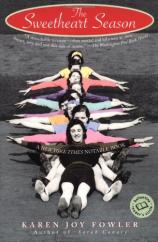
The Sweetheart Season
by Karen Joy Fowler
List Price: $12.95
Pages: 384
Format: Paperback
ISBN: 0345416422
Publisher: Ballantine Books
As a rebellious daughter of the sixties recalls the year her mother played baseball in 1947, two luminous stories begin to unfold in America's heartland, one lived and one imagined....
top of the page

1. Why does the narrator of The Sweetheart Season state up front that the story she is about to tell is "told by two liars"?
2. The narrator is a child of the 1960s--a person labeled a "baby boomer" by popular culture. How does her perception shape the story, and what shaped her perception?
3. How do you think World War II shaped the ethos of the country in the 1940s?
4. Irini Doyle and her daughter, the narrator of the book, both came of age during a time of war--World War II and the Vietnam War--yet their experiences, opinions, and attitudes are vastly different. Why?
5. Do you think women today are anything like Maggie Collins, whom the narrator describes as "a tidy, indefatigable, even-tempered, ageless woman...she shared the scientist's obsession with reliable, predictable results...and she was as interested in innovation as she was in codification"? What about women of the 1940s?
6. What does the narrator think about the culture and climate of the 1940s?
7. Conservative social critics frequently call for a return to the simpler values of America's past--particularly the values of the 1940s and '50s. Do you think things are better now or were they better back then? Why do many of us tend to romanticize the past, whether it's our own past or that of our ancestors?
8. Which mind-sets and behaviors have changed since the 1940s? Which do you wish had stayed the same?
9. Do you think the Vietnam War and World War II had different effects on the young Americans who lived through them? If so, why?
10. Why do you think the author has chosen to make Irini Doyle motherless with an alcoholic father?
11. Why does Fowler make Upper and Lower Magrit in dissension? And what role does the sunken part of the city play in the story?
12. Is Henry Collins anything like today's business tycoons? How does he compare to modern captains of industry such as Bill Gates, Lee Iacocca, Donald Trump, and Ted Turner?
13. Is Ada Collins, genteel bohemian and former Communist turned follower of Ghandi, the antithesis of Maggie Collins? Explain how Henry Collins could be in love with two such dissimilar women.
14. What's the significance of the fictitious radio character little Anna Peal? What purpose does she serve?
15. Discuss the following quote from Irini Doyle's father: "The whole world has been sugar-coated. It's this labored American blandness. This forced optimism. It happened during the war, somehow. Darndest thing. We've seen the concentration camps. The mass suicides of the Japanese. We've seen hostages shot and hanged, whole cities obliterated in a blink. And we still think we live in a Disney cartoon." Do you agree?
16. Why did men consider it so undesirable for women to be strong and competitive in the 1940s? Do you think most men still feel threatened by women who excel in sports and things that are physical?
17. Why do you suppose the author chooses the character she does to be responsible for writing Maggie's final columns, which urge women to "Flee through the open space with only the clothes on your back. What you need most after food and sleep is silence and time. You will not find these in your house with the white picket fence and the screaming children and the glowering husband. Live in the woods, eat like the birds. Wear your feather dusters as hats; make hammocks out of your aprons. Warm yourself at the primitive fires. Be nameless. Life is a smorgasbord. Take many lovers, you will be surprised at how many people are edible if you prepare them properly."
18. Karen Joy Fowler is a cocreator of the James Tiptree Jr. Memorial Award, which is presented, in her words, "to a short story or novel that explores or expands our understanding of gender...to remind the field of its own importance in the continual struggle to re-imagine more livable sexual roles for ourselves." How does The Sweetheart Season accomplish this goal?
top of the page

"Ms. Fowler's willingness to take detours, her unapologetic delight in the odd historical fact, her shadowy humor, and the elegant unruliness of her language all elevate her story from the picaresque to the grand."
The New York Times Book Review
"A combination of inquiry, skepticism, and sympathy voiced wth a zany appeal, a hint of magic...Its flavor is tart, comic, and unreliable"
The Los Angeles Times
"Smart, wry, and just this side of insane...A remarkable treasure...Enchanting"
The Washington Post
"The Sweetheart Season is the sort of novel that makes the reader want to meet the author....The characters are entertaining and well-defined. The plot twists are unexpected, and Fowler's witty writing is a joy to read"
USA Today
"The Sweetheart Season is full of sparkling wit and flat-out good writing about a town where someone can be suspected of putting on airs simply by sporting an 'out of town haircut.' In territory long staked out by Garrison Keillor, Fowler's book reads like the best of Lake Wobegon and then some"
The Philadelphia Inquirer
"The Sweetheart Season is a brilliantly evoked re-creation of the post-war period in small-town America, filled with well-drawn characters....A complex mixture of generosity and skepticism, a warm meditation on and paean to those most romantic American traits: the propensity for optimism in reduced circumstances, a gullible faith in the unexpectedness and persistence of love, and an unshakable sense of irony that is large enough to embrace both humor and affection"
San Francisco Chronicle
"Fowler loves raising questions about where reality ends and imagination begins....If you're willing to take chances on writers who color outside the lines, try Fowler. She's a true original and one of the funniest people currently writing in the English language"
Minneapolis Star Tribune
"Fowler's authentically detailed and clever novel is frequently digressive, but the digressions charm. Deadpan irony ('The Baldishes had been among the first to explore decorating with deer') and quirky characters worthy of Dickens raise the entertainment quotient....Fowler depicts our nation's past as more surreal than real while at the same time slamming her book out of the ballpark"
Publishers Weekly