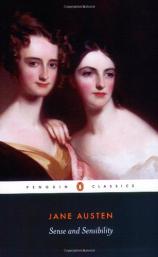
Sense and Sensibility
by Jane Austen
List Price: $7.00
Pages: 448
Format: Paperback
ISBN: 0141439661
Publisher: Penguin Classic
(Excerpted from The Jane Austen Book Club)
Sense and Sensibility was written in the late 1790s but much revised before publication in 1811. It is primarily the story of two sisters, Elinor and Marianne Dashwood. The death of their father has left them, with their mother and younger sister, financially pressed. Both women fall in love, each in her own characteristic way --- Marianne is extravagant and public with her emotions, Elinor restrained and decorous.
The object of Elinor's interest is Edward Ferrars, brother to Fanny Dashwood, her odious, stingy sister-in-law. Elinor learns that Edward has been for some time secretly, unhappily, and inextricably engaged to a young woman named Lucy Steele. She learns this from Lucy, who, aware of Elinor's interest though pretending not to be, chooses Elinor as her special confidante.
Marianne hopes to marry John Willoughby, the book's only sexy man. He deserts her for a financially advantageous match. The Surprise and disappointment of this sends Marianne into a dangerous decline.
When Lucy Steele jilts Edward for his brother Robert, Edward is finally free to marry Elinor. Edward seems quite dull but at least her own choice. Marianne marries Colonel Brandon, the dull man Elinor and her mother have picked out for her.
top of the page

1. As the title suggests, Sense and Sensibility is, in some ways, a debate about the principles of rationalism, represented by Elinor Dashwood, and those of Romanticism, represented by her sister Marianne.
Few Austen heroines are set up so approvingly as Elinor is. Yet novelist David Gates has described her as "ambivalent a heroine as Mansfield Park's notoriously hard-to-warm-up-to Fanny Price."
Why would he say such a thing?
2. And what about Marianne?
3. One of the tenets of Romanticism is that instinct and emotion are better moral guides than reason. At one point in the book, Marianne tells Elinor that if she (Marianne) were doing anything wrong, she (Marianne) would know it.
Do people usually know when they're doing something wrong?
Do you think Austen thinks so?
Does Marianne do anything wrong?
4. A turn of the century review describes Mrs. Jennings as a character it is "equally delightful to have met on paper and not to have met in the flesh." Why is it delightful to spend time reading about a character who would be tedious in person?
Might a character be every bit as tedious on paper as in person? Can you think of examples?
5. Think for a moment about the scene in which Lucy tells Elinor about her secret engagement to Edward. It is a scene full of secrets.
The conversation takes place in whispers so as to be kept secret from everyone else in the room.
Ostensibly Lucy is confiding a secret. But she is simultaneously keeping one, in that she knows Elinor is a rival and wishes to warn her off without appearing to do so.
Elinor is keeping from Lucy the secret of her own painful feelings.
She will keep Lucy's secret a secret, though doing so prevents her from being open with anyone. Elinor spends much of the book utterly isolated by this secret.
Sometimes it seems that everyone in Sense and Sensibility has a secret. Make a list.
6. Although the women are beautifully delineated, Sense and Sensibility's leading men remain somewhat shadowy. "For my money Edward is the least likable of Austen's heroes," David Gates has said, "while his opposite number, Willoughby, is the most sympathetic of Austen's libertines." Discuss.
7. Why doesn't Colonel Brandon fall in love with Elinor?
8. Critic William H. Galperin does not like Colonel Brandon. He has characterized Brandon's pursuit of Marianne as "insistent, if sinister."
As one part of his case against Brandon, he refers to two points in Willoughby's final conversation with Elinor in which anonymous informants figure. "Mrs. Smith had somehow or other been informed" Willoughby says, of his affair with Eliza, and later "some vague report" of Marianne reaches his fiancée. William H. Galperin has argued that this unnamed informant can only be Colonel Brandon.
Is it possible that Colonel Brandon is, in fact, the evil mastermind behind the entire
plot?
Did you suspect as much?
9. Elinor considers Lucy's marriage to Robert Ferrars as "extraordinary and unaccountable," "completely a puzzle." Is it completely a puzzle to you as well?
10. Willoughby's final confession to Elinor is one of the books more unsettling and unexpected scenes. It allows us in some part (how much?) to forgive and pity him. It reminds us that he is the only sexy man in the book. It reminds us that Marianne once wanted a marriage in the Romantic tradition and has got a rational one instead. How do you feel about that?
Does Sense and Sensibility have a happy ending?
Why does Lucy get to be happier than Willoughby?
top of the page

"These modern editions are to be strongly recommended for their scrupulous texts, informative notes and helpful introductions."
Brian Southam, the Jane Austen Society