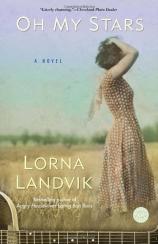
Oh My Stars


Review
Oh My Stars




Lorna Landvik is a name that always catches this reader's attention. Whenever she has a new book out, it automatically is on the must-read list. While OH MY STARS is quite different from PATTY JANE'S HOUSE OF CURL and her more recent ANGRY HOUSEWIVES EATING BON BONS, Landvik's latest does not disappoint./p>
This is the story of Violet Mathers, a woman who started out in life unloved and unwanted. She was made fun of by her peers and by her family, and when she is left with only one arm following a horrific accident in a sewing factory, she knows that her only choice is to end her life. At the age of 18, she leaves her father, gets on a bus bound for San Francisco, and patiently waits for the bus to end its journey. Her plan is to be the second person to end their life by jumping off the Golden Gate Bridge.
But fate has something else in store for Violet. The bus never makes it to the West Coast. An accident that leaves the bus stranded in North Dakota becomes the turning point in her life. A family kindly takes her in. One of the family members, a handsome young man named Kjel (pronounced "Shell"), patiently and lovingly helps change Violet from a very depressed and insecure teenager to a confident and happy woman. To say it simply, Kjel gives Violet a reason to live.
Soon after, Kjel and his good friend Austin, a black man for whom Violet feels repulsion in the beginning, decide they want to travel around the country. Their story takes place in the late 1930s, and she has been taught that white and black people do not mix. Kjel, however, never sees a color difference, and the two men are best friends. Kjel convinces Austin and Violet that they are going with him on this trip. They leave North Dakota and take off for parts unknown, with no plans except to travel.
What happens next is the adventure of a lifetime. With the help of Austin's brother Dallas, and Violet as their manager, they form a musical band called the Pearltones, in tribute to their hometown of Pearl, North Dakota. Their lives take on the form of a dream. Kjel becomes an Elvis-like heartthrob, and they help break color barriers with their music. Fans crowd into clubs and bars to hear them perform, with women young and old swooning at their feet. They encounter racism along the way, as well as lasting friendships, loyalty, and not least of all, love.
Although the story is difficult to follow at times due to the jumping back and forth between time sequences, OH MY STARS is a wonderful novel. While the story is rooted in history, in particular the segregation of whites and blacks, it also takes on a fantastical dreamy type of fable. The story of Violet's early life is a downer, but this is the type of book that, when the last page is turned, makes you feel good all over, and you will remember the characters for a very long time afterward.
The story is told through Violet's eyes as an elderly woman reminiscing about a life that could have ended too soon. The book concludes with Violet's narration, remarking, "Who'd have ever thought a shunned, husky-voiced, one armed, big-chinned girl with a hive of bees in her head could live a life so full of miracles?" It's nice to know that some books do have happy endings.
Reviewed by Marie Hashima Lofton on January 13, 2011


Oh My Stars
- Publication Date: February 28, 2006
- Genres: Fiction
- Paperback: 416 pages
- Publisher: Ballantine Books
- ISBN-10: 0345468368
- ISBN-13: 9780345468369