Reading Group Guide
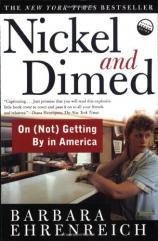
Nickel and Dimed
On (Not) Getting By in America
by Barbara Ehrenreich

List Price: $13.00
Pages: 230
Format: Paperback
ISBN: 0805063897
Publisher: Owl Books

Click here to buy this book from Amazon.com.
Click here to buy this book from Amazon.ca.


About This Book


Millions of Americans work for poverty-level wages, and one day Barbara Ehrenreich decided to join them. She was inspired in part by the rhetoric surrounding welfare reform, which promised that any job equals a better life. But how can anyone survive, let alone prosper, on $6 to $7 an hour? To find out, Ehrenreich moved from Florida to Maine to Minnesota, taking the cheapest lodgings available and accepting work as a waitress, hotel maid, house cleaner, nursing-home aide, and Wal-Mart salesperson. She soon discovered that even the "lowliest" occupations require exhausting mental and physical efforts. And one job is not enough; you need at least two if you intend to live indoors.

Nickel and Dimed reveals low-wage America in all its tenacity, anxiety, and surprising generosity -- a land of Big Boxes, fast food, and a thousand desperate strategies for survival. Instantly acclaimed for its insight, humor, and passion, this book is changing the way America perceives its working poor.

top of the page


rgg_discuss.gif (1294 bytes)


1. In the wake of recent welfare reform measures, millions of women entering the workforce can expect to face struggles like the ones Ehrenreich confronted in Nickel and Dimed.

Have you ever been homeless, unemployed, without health insurance, or held down two jobs? What is the lowest-paying job you ever held and what kind of help -- if any -- did you need to improve your situation?

2. Were your perceptions of blue-collar Americans transformed or reinforced by Nickel and Dimed? Have your notions of poverty and prosperity changed since reading the book? What about your own treatment of waiters, maids, and sales-people?

3. How do booming national and international chains -- restaurants, hotels, retail outlets, cleaning services, and elder-care facilities -- affect the treatment and aspirations of low-wage workers? Consider how market competition and the push for profits drive the nickel-and-diming of America's lowest-paid.

4. Housing costs pose the greatest obstacle for low-wage workers. Why does our society seem to resist rectifying this situation? Do you believe that there are realistic solutions to the lack of affordable housing?

5. While working for The Maids, Ehrenreich hears Ted claim that he's "not a bad guy . . . and cares a lot about his girls." How do the assumptions of supervisors such as Ted affect their employees? How does Ted compare to Ehrenreich's other bosses? To yours?

6. Ehrenreich is white and middle class. She asserts that her experience would have been radically different had she been a person of color or a single parent. Do you think discrimination shaped Ehrenreich's story? In what ways?

7. Ehrenreich found that she could not survive on $7.00 per hour -- not if she wanted to live indoors. Consider how her experiment would have played out in your community: limiting yourself to $7.00 per hour earnings, create a hypothetical monthly budget for your part of the country.

8. Ehrenreich experienced remarkable goodwill, generosity, and solidarity among her colleagues. Does this surprise you? How do you think your own colleagues measure up?

9. Why do you think low-wage workers are reluctant to form labor organizations as Ehrenreich discovered at Wal-Mart? How do you think employees should lobby to improve working conditions?

10. Many campus and advocacy groups are currently involved in struggles for a "living wage." How do you think a living wage should be calculated?

11. Were you surprised by the casual reactions of Ehrenreich's coworkers when she revealed herself as an undercover writer? Were you surprised that she wasn't suspected of being "different" or out-of-place despite her graduate-level education and usually comfortable lifestyle?

12. How does managers' scrutiny -- "time theft" crackdowns and drug testing -- affect workers' morale? How can American companies make the workplace environment safe and efficient without treating employees like suspected criminals?

13. Ehrenreich concluded that had her working life been spent in a Wal-Mart -- like environment, she would have emerged a different person -- meaner, pettier, "Barb" instead of "Barbara." How would your personality change if you were placed in working conditions very different from the ones you are in now?

14. The workers in Nickel and Dimed receive almost no benefits -- no overtime pay, no retirement funds, and no health insurance. Is this fair? Do you think an increase in salary would redress the lack of benefits, or is this a completely separate problem?

15. Many of Ehrenreich's colleagues relied heavily on family -- for housing and help with child-care, by sharing appliances and dividing up the cooking, shopping, and cleaning. Do you think Americans make excessive demands on the family unit rather than calling for the government to help those in need?

16. Nickel and Dimed takes place in 1998-2000, a time of unprecedented prosperity in America. Do you think Ehrenreich's experience would be different in today's economy? How so?

17. After reading Nickel and Dimed, do you think that having a job -- any job -- is better than no job at all? Did this book make you feel angry? Better informed? Relieved that someone has finally described your experience? Galvanized to do something?

top of the page

Critical Praise

"Jarring, full of riveting grit . . . This book is already unforgettable."
Susannah Meadows, Newsweek


"Valuable and illuminating . . . We have Barbara Ehrenreich to thank for bringing us the news of America's working poor so clearly and directly, and conveying with it a deep moral outrage. . . . She is our premier reporter of the underside of capitalism."
Dorothy Gallagher, The New York Times Book Review


"impassioned, fascinating, profoundly significant, and wildly entertaining . . . I kept grabbing family members and phoning friends to read passages aloud."
Francine Pose, O: The Oprah Magazine


". . . you will read this explosive little book cover to cover and pass it on to all your friends and relatives."
Diana Henriques, The New York Times [Business Section]


"Angry, amusing . . . An in-your-face expose."
Anne Colamosca, Business Week


"With grace and wit, Ehrenreich discovers . . . the irony of being nickel and dimed during unprecedented prosperity."
Eileen Boris, The Boston Globe


"Ehrenreich is a superb and relaxed stylist [with] a tremendous sense of rueful humor."
Stephen Metcalf, Los Angeles Times Book Review


"Reading Ehrenreich is good for the soul."
Molly Ivins


"Ehrenreich is passionate, public, hotly lucid, and politically engaged."
Chicago Tribune


"Ehrenreich's scorn withers, her humor stings, and her radical light shines on."
The Boston Globe


"Barbara Ehrenreich is smart, provocative, funny, and sane in a world that needs more of all four."
Diane Sawyer


Back to top.   


Privacy Policy | Contact Us | Advertising | About Us

<© Copyright 2001-2008, ReadingGroupGuides.com. All rights reserved.