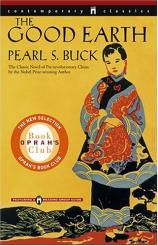
The Good Earth


Review
The Good Earth




"The earth lay rich and dark and fell apart lightly under the points of their hoes. Sometimes they turned up a bit of brick, a splinter of wood. It was nothing. Some time, in some age, bodies of men and women had been buried there, houses had stood there, had fallen, and gone back into the earth. So would also their house, some time, return into the earth, their bodies also. Each had his turn at this earth. They worked on, moving together --- together --- producing the fruit of this earth --- speechless in their movement together."
The simple raw imagery of THE GOOD EARTH won Pearl S. Buck the Pulitzer Prize for Literature in 1932. Its poignant portrayal of a poor farmer's life and his bond with the land is as relevant to our own ancestral roots as it is to rural China. Wang Lung, the central figure around which the entire narrative revolves, is a man of many complexities depicted by his relationships with his wife, his father, his children and his village. His land is precious, its value equating to his own self-worth. Although steeped in the ancient traditions, he reflects certain enlightened thinking at times that may be more for the author's emphasis of injustices than a true depiction of the average Chinese peasant in the early 1900s.
Wang Lung's story begins as a young man seeking a wife to cook, clean and bear his children. O-lan, a slave's slave from a wealthy household, comes to live and share his life in the subservient fashion that traditions dictate. Initially their marriage brings satisfaction to both, although for vastly different reasons. Wang Lung has a sense of fulfillment in having such a wise and competent woman to raise his children and maintain his home. And even though women are still considered "slaves" by their men, O-lan has found a better life than she's ever known; she is well-cared for and Wang Lung is kind. Together they bring five children into the world and work their thriving farm.
But just as the life of a peasant is harsh, so are the traditions that mold marriage and family. Women are little more than chattel, necessary for procreation and to serve the household needs. A girl child is an unwelcome birth and can even bring shame to families unable to produce a boy. During hard times young girls were often sold into slavery or worse. For all the compassion that Pearl Buck feels for these people and the beauty she finds in their simple lives, her outrage at the conditions of the women is apparent. Although Wang Lung's thoughts are a bit more liberal than we might expect, he still maintains his distance, displaying neither open affection nor love for the woman who shares his life.
". . . she was like a faithful, speechless serving maid, who is only a serving maid and nothing more. And it was not meet that he should say to her, 'Why do you not speak?' It should be enough that she fulfilled her duty."
"Sometimes, working over the clods in the fields, he would fall to pondering about her. What had she seen in those hundred courts? What had been her life, that life she never shared with him? He could make nothing of it. And then he was ashamed of his own curiosity and of his interest in her. She was, after all, only a woman."
As the years pass, Wang Lung's family suffers abject poverty and famine but their strength of character sustains them through stark conditions that we would find inconceivable. Reduced to begging in the city, Wang Lung steadfastly refuses to sell his land. Then as China experiences the first rumblings of revolution, the cycle of prosperity returns and Wang Lung eventually becomes the wealthy landowner that he once envied and despised. But his evolution from a proud hardworking peasant to the decadent life of an idle lord is disheartening. Pearl Buck eloquently portrays the sad disintegration of this man and his family as they become alienated from the land and the noble values it imparted.
Reviewed by Ann Bruns on January 22, 2011


The Good Earth
- Publication Date: September 15, 2004
- Genres: Fiction
- Paperback: 368 pages
- Publisher: Washington Square Press
- ISBN-10: 0743272935
- ISBN-13: 9780743272933